Introduction
While much attention has focused on the GLP-1 revolution in weight loss, a quieter transformation is unfolding in cardiology.
In 2026, cardiovascular disease remains the leading cause of death worldwide. However, peptide therapeutics are moving far beyond symptom control.
We are entering the era of precision cardiology. Peptides now help repair heart tissue, manage resistant hypertension, and stabilize heart failure with biological accuracy.
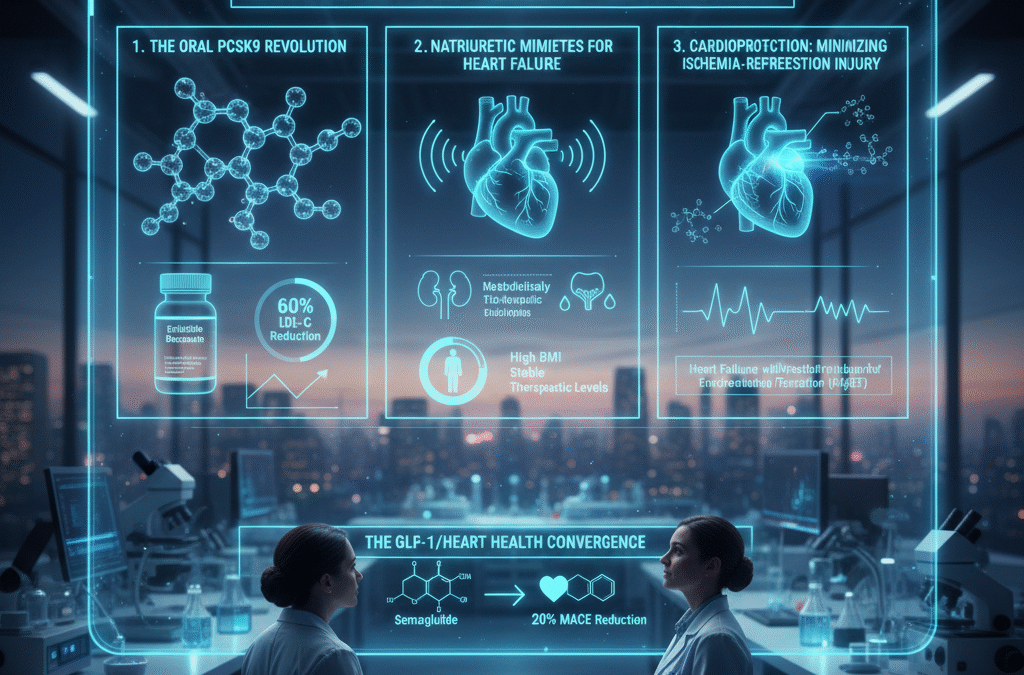
1. The Oral PCSK9 Revolution: Enlicitide Decanoate
Cholesterol management is changing rapidly.
What once required bi-monthly injections is shifting to a once-daily pill.
Enlicitide Decanoate
In 2026, Enlicitide Decanoate, Merck’s macrocyclic peptide, has emerged as a major breakthrough. It is the first oral PCSK9 inhibitor to deliver antibody-level LDL reduction in tablet form.
Clinical Impact
Recent Phase 3 trials show LDL-C reductions of up to 60%.
This provides a powerful option for nearly 70% of high-risk patients who fail to meet lipid goals with statins alone.
2. Natriuretic Peptide Mimetics for Heart Failure
Heart failure treatment is shifting toward the Natriuretic Peptide System (NPS), which regulates fluid balance and vascular tone.
Designer Natriuretic Peptides
In 2026, synthetic natriuretic peptides that mimic ANP and BNP are advancing rapidly. These peptides promote vasodilation and fluid excretion, easing the heart’s workload.
Precision Dosing in Obesity
Obesity can blunt natural peptide signaling.
Synthetic mimetics overcome this limitation by maintaining consistent therapeutic levels, even in patients with high BMI. As a result, clinicians achieve more reliable heart failure control.
3. Cardioprotection: Limiting Ischemia-Reperfusion Injury
One of the most exciting developments in 2026 is real-time heart protection during heart attacks.
Ischemic Shielding
New peptides reduce ischemia-reperfusion injury—the damage that occurs when blood flow is restored after a blockage. This protection limits tissue death and improves recovery.
Metabolically Stable Peptide Analogues
Apelin-based peptide analogues are showing strong promise.
These compounds reduce myocardial necrosis and restore heart tissue without causing dangerous drops in blood pressure.
4. The GLP-1 and Heart Health Convergence
GLP-1 peptides such as Semaglutide and Tirzepatide now play a major role in cardiovascular care.
Reduced Cardiovascular Events
Large trials, including the SELECT study, show a 20% reduction in major adverse cardiovascular events (MACE) in patients with obesity.
HFpEF Breakthroughs
GLP-1 therapies also benefit patients with heart failure with preserved ejection fraction (HFpEF). They reduce inflammation, improve metabolic strain, and lower hospitalization and mortality rates.
Conclusion
The 2026 cardiovascular landscape confirms that peptides are no longer secondary therapies.
From oral PCSK9 inhibitors to cardioprotective peptides that act during acute events, peptide therapeutics now sit at the center of modern heart care.
Precision cardiology has arrived—and peptides are leading the way.