Introduction
In 2026, the obesity conversation officially changed.
The focus shifted from willpower to biology. At the center of this shift is GLP-1 (Glucagon-Like Peptide-1).
Originally identified as a gut hormone, GLP-1 now powers the most in-demand weight-loss medications in the world. As a result, society no longer views obesity as a personal failure. Instead, it is understood as a biological condition that can be treated effectively.
The Mechanism of “Food Quiet”
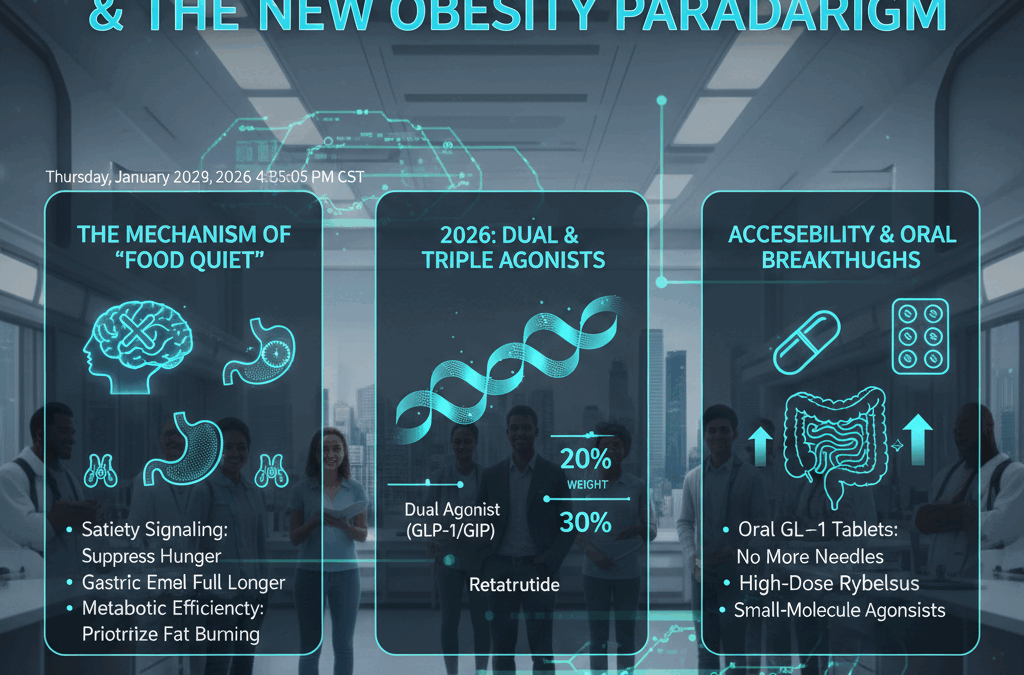
GLP-1 peptides reduce obesity through several coordinated biological actions. Together, these effects create what many patients describe as “food quiet.”
Satiety Signaling
First, GLP-1 peptides cross into the hypothalamus.
There, they suppress hunger signals and reduce constant thoughts about food. Consequently, patients experience fewer cravings and improved control over eating behaviors.
Gastric Emptying
Next, GLP-1 peptides slow gastric emptying.
Food stays in the stomach longer, which increases feelings of fullness. As a result, people eat less without feeling deprived.
Metabolic Efficiency
Finally, GLP-1 peptides improve insulin sensitivity.
This shift allows the body to burn fat more efficiently rather than store it. Over time, metabolic flexibility improves and weight loss becomes sustainable.
The 2026 Landscape: From Dual to Triple Agonists
While early GLP-1 drugs laid the foundation, 2026 marks a new era.
Today’s therapies go far beyond single-pathway activation.
Dual Agonists (GLP-1 / GIP)
Dual-agonist peptides such as Tirzepatide continue to lead the market.
By activating both GLP-1 and GIP receptors, these drugs deliver powerful results. In many cases, patients achieve 20% or more total body weight loss, approaching outcomes once reserved for bariatric surgery.
Triple Agonists (GLP-1 / GIP / Glucagon)
Even more advanced therapies are now emerging.
Triple-agonist peptides like Retatrutide activate three metabolic pathways at once.
In addition to appetite suppression, these peptides increase resting metabolic rate. As a result, clinical data now shows weight-loss results approaching 30% in late-stage trials.
Accessibility and Oral Breakthroughs
For years, injections limited adoption.
However, that barrier is rapidly disappearing.
In 2026, oral GLP-1 formulations—including high-dose Rybelsus and new small-molecule agonists—expand access dramatically. Because patients can now choose tablets instead of injections, adoption continues to accelerate.
Consequently, market volume is rising sharply. Millions of people who once avoided treatment now have practical, effective options.
Conclusion
GLP-1 peptides have permanently changed obesity treatment.
They quiet food noise, improve metabolic efficiency, and deliver unprecedented weight-loss outcomes.
Most importantly, they have reframed obesity as a treatable biological condition. As innovation continues, GLP-1 and next-generation agonists will remain at the center of metabolic medicine for years to come.