Introduction
For decades, the central nervous system (CNS) represented the final frontier of pharmaceutical treatment.
Diseases such as Alzheimer’s, Parkinson’s, and Amyotrophic Lateral Sclerosis (ALS) remained difficult to treat due to one major obstacle: the Blood-Brain Barrier (BBB).
This highly selective barrier blocks nearly 98% of small-molecule drugs from entering the brain. However, in 2026, the breakthrough is clear. It is not just new drugs—but peptide-based delivery systems that allow safe, targeted treatment without invasive surgery.
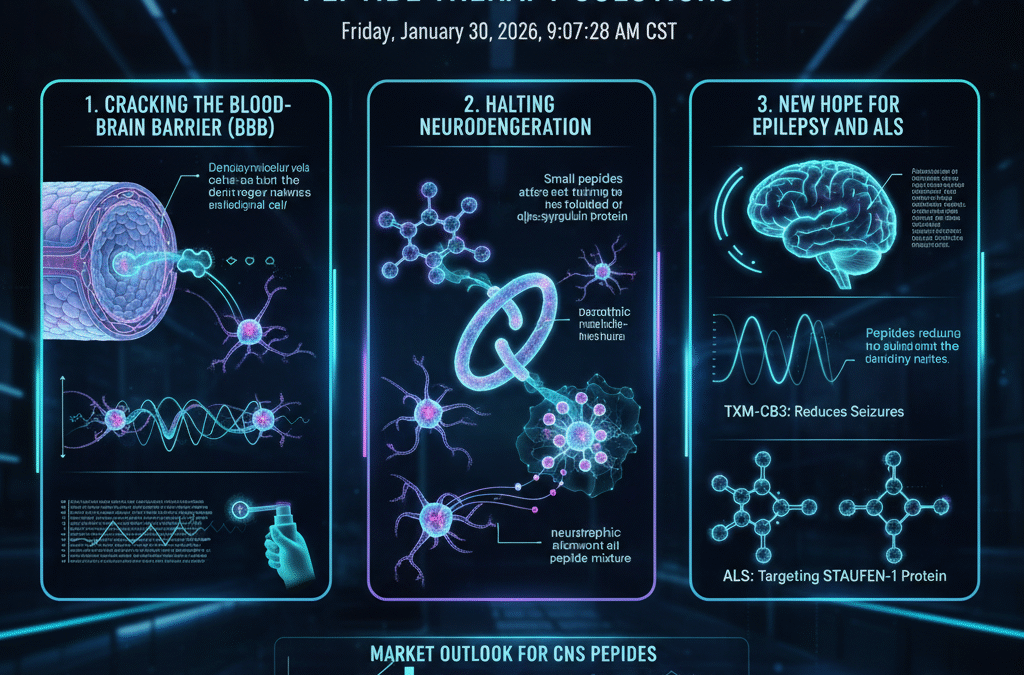
1. Cracking the Blood-Brain Barrier (BBB)
For years, peptides were considered too fragile or too large to reach the brain.
In 2026, that belief has been completely overturned.
Three major innovations now define CNS peptide delivery.
Shuttle Peptides: Molecular Trojan Horses
First, shuttle peptides exploit natural BBB transport systems.
These peptides bind to receptors such as the transferrin receptor, tricking the barrier into transporting therapeutic cargo into the brain.
As a result, anti-inflammatory and neuroprotective drugs can reach brain tissue directly and efficiently.
Supramolecular Peptides: “Dancing Molecules”
Next, researchers have developed supramolecular therapeutic peptides (STPs).
Often referred to as “dancing molecules,” these peptides are highly mobile and adaptable.
A major 2026 breakthrough from Northwestern University shows that STPs can cross the BBB and repair nerve tissue following stroke or spinal cord injury with unprecedented efficiency.
Intranasal Nose-to-Brain Delivery
Finally, intranasal peptide delivery bypasses the BBB entirely.
Using nasal sprays, peptides travel along the olfactory nerves directly into the brain.
Because of this, nose-to-brain delivery is becoming a preferred option for early-stage Alzheimer’s treatment and other neurodegenerative conditions.
2. Halting Neurodegeneration in Alzheimer’s and Parkinson’s
In 2026, neurological care is no longer limited to symptom management.
Instead, peptide therapies are targeting the root causes of neurodegeneration.
Inhibiting Toxic Protein Clumping
New peptides act as molecular caps.
They stabilize proteins such as amyloid-beta in Alzheimer’s and alpha-synuclein in Parkinson’s.
By locking these proteins into healthy configurations, peptides prevent toxic clumps from forming—protecting neurons from damage.
Neurotrophic Peptide Support
At the same time, neurotrophic peptide mixtures are gaining traction.
These peptides mimic the body’s natural growth factors.
As a result, damaged neurons can repair themselves, form new connections, and potentially reverse early cognitive decline.
3. New Hope for Epilepsy and ALS
Peptide therapy is also expanding into acute and rare neurological disorders.
Epilepsy Progression Control
In early 2026 studies, the experimental peptide TXM-CB3 showed promise in reducing recurrent seizures.
Rather than sedating patients, it works by calming stress signaling pathways in the brain.
This offers a safer, non-sedating alternative to traditional anti-epileptic drugs.
ALS and Targeted Protein Reduction
For ALS, researchers are targeting STAUFEN-1, a protein linked to neuron death.
Peptides designed to lower STAUFEN-1 levels are showing early potential to slow disease progression.
4. Market Outlook for CNS Peptide Therapies
The neurological peptide segment is one of the fastest-growing areas of the peptide therapeutics market.
As the global population ages, demand for neuroprotective therapies continues to rise. The CNS peptide market is projected to grow at a 11.5% CAGR through 2030.
Additionally, FDA and EMA fast-track designations for rare neurological diseases are accelerating development. As a result, the CNS peptide pipeline has never been stronger.
Conclusion
The brain is no longer unreachable.
Through advanced peptide design and innovative delivery systems, 2026 marks the year neurological diseases move from passive observation to active intervention.
By targeting disease pathways at the molecular level, peptide therapies offer real hope for Alzheimer’s, Parkinson’s, epilepsy, ALS, and beyond. The future of neurological medicine has arrived—and it is peptide-powered.