Introduction
In 2026, cancer treatment has reached a critical turning point.
While chemotherapy and radiation remain foundational, they often act as blunt instruments. Healthy tissue suffers alongside the tumor.
Peptide-based cancer therapeutics are changing that reality. By leveraging high specificity and low toxicity, peptides allow oncology to shift toward a precision-strike model. Cancer cells are targeted directly, while healthy cells remain largely unharmed.
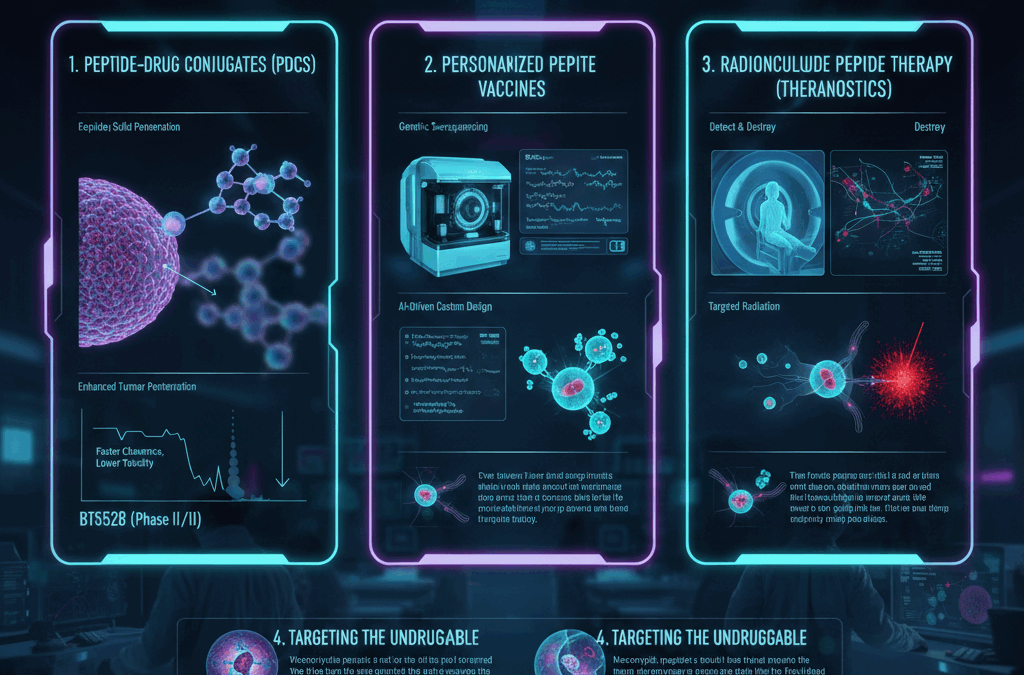
1. Peptide-Drug Conjugates (PDCs): The Next Evolution
If Antibody-Drug Conjugates (ADCs) represented the first wave of targeted delivery, Peptide-Drug Conjugates (PDCs)are the faster, more precise successors.
In 2026, PDCs are gaining momentum for several key reasons.
Enhanced Tumor Penetration
Peptides are significantly smaller than antibodies.
As a result, PDCs penetrate deep into dense solid tumors that ADCs often cannot reach.
Faster Clearance, Lower Toxicity
PDCs clear from the bloodstream more quickly.
This rapid clearance dramatically reduces off-target toxicity, one of the major drivers of severe chemotherapy side effects.
Current Breakthroughs
Promising molecules such as BT5528 target tumor-specific antigens and are advancing through Phase II/III trials. These therapies demonstrate strong efficacy in hard-to-treat solid tumors with minimal systemic damage.
2. Personalized Peptide Vaccines: A 2026 Reality
The concept of a cancer vaccine is no longer theoretical.
In 2026, personalized neoantigen peptide vaccines have become a central pillar of immuno-oncology.
How Personalized Peptide Vaccines Work
First, a patient’s tumor undergoes genetic sequencing.
Unique mutations, known as neoantigens, are identified.
Next, AI-driven algorithms design a custom peptide cocktail tailored to those mutations. These peptides are then synthesized and administered to the patient.
Turning the Immune System Into a Precision Weapon
Once injected, these peptides prime T-cells to recognize and attack cancer cells with surgical accuracy. The immune system becomes a guided missile, calibrated specifically to the patient’s tumor.
Universal Peptide Vaccine Targets
Some vaccines offer broader application.
For example, OVM-200 targets survivin—a protein present in approximately 90% of cancers—providing an off-the-shelf option for lung and prostate cancers.
3. Radionuclide Peptide Therapy (Theranostics)
In 2026, Peptide Receptor Radionuclide Therapy (PRRT) has entered widespread clinical use. This theranostic approach allows clinicians to both detect and destroy cancer.
The “Search and Destroy” Strategy
First, a peptide labeled with a mild radioactive tracer maps every tumor site using PET imaging.
Next, the same peptide is paired with a therapeutic radioactive payload.
This second phase delivers lethal radiation directly to cancer cells—while sparing surrounding healthy tissue.
4. Targeting the “Undruggable”
Many cancer-driving proteins exist inside the cell, beyond the reach of traditional drugs.
In 2026, cell-penetrating peptides (CPPs) and macrocyclic peptides are finally unlocking these targets.
These advances offer new hope for aggressive cancers such as leukemia and pancreatic cancer, where treatment options were previously limited.
Conclusion
Modern oncology is now defined by specificity.
As the peptide-based cancer therapeutics market grows toward its projected $24.8 billion valuation by 2035, the goal has shifted.
Cancer treatment is no longer about surviving therapy.
It is about targeted eradication.
Peptides are not simply an alternative to chemotherapy. They represent the future of precision oncology—and a meaningful step toward a cancer-free world.